
Ever feel like you’re flying blind while your competitors seem to have it all figured out? Here’s the truth: competitor analysis isn’t corporate espionage. It’s not about stealing ideas or copying what your rivals do. Instead, it’s about studying the landscape to find the gaps they’re leaving wide open, and stepping right into those opportunities before anyone else does.
Most small business owners either ignore their competition entirely or obsess over them to the point of paralysis. Both approaches leave money on the table. Smart competitor intelligence sits right in the middle: ethical, strategic, and brutally effective.
Let’s talk about how to spy on your rivals without crossing any lines, and how to turn what you learn into real competitive advantage.
Why Competitor Analysis Isn’t About Copying, It’s About Finding Gaps
Think of competitor analysis like studying a chess board. You’re not copying your opponent’s moves, you’re identifying the squares they’ve left undefended.
When you analyze what your competitors are doing, you’re looking for three critical things:
- What they’re doing well (so you don’t waste time reinventing the wheel)
- What they’re ignoring (your opportunity to dominate)
- What their customers are complaining about (your chance to be the solution)
This isn’t about becoming a knockoff version of your biggest rival. It’s about understanding the battlefield so you can position your business where the demand is highest and the competition is weakest.
Additionally, ethical competitor intelligence keeps you from making expensive mistakes. If your competitor tried a strategy and it flopped spectacularly, you just saved yourself thousands of dollars and months of wasted effort.

The Meta Ad Library: Your Free Window Into Their Strategy
Want to know exactly what ads your competitors are running on Facebook and Instagram? Meta literally hands you this information for free.
The Meta Ad Library is a publicly searchable database of every active ad running on Meta’s platforms. You can see their messaging, their visuals, their targeting angles, everything except the actual targeting parameters and budget.
Here’s how to use it:
- Go to facebook.com/ads/library
- Search for your competitor’s business name
- Filter by “Active Ads” to see what’s running right now
- Pay attention to which ads have been running the longest (those are the winners)
What should you look for? Focus on their messaging. Are they emphasizing price? Speed? Quality? Customer service? The ad copy they’re investing money behind tells you exactly what’s resonating with your shared audience.
However, don’t just copy their ads word-for-word. Instead, look for the gaps. If they’re hammering “lowest prices,” you might position yourself as “premium quality worth paying for.” If they’re emphasizing fast turnaround, you could focus on thorough, detail-oriented service.
Actionable Tip: Screenshot their top-performing ads and create a swipe file. Review it monthly to spot trends in their messaging and pivot accordingly.
Mining Gold from Their Google Business Profile Reviews
Your competitors’ Google Business Profile reviews are a goldmine of competitor analysis insights, if you know how to read between the lines. If you want a quick benchmark for what “good” looks like (before you compare yourself to everyone else), start with The Clarity Audit Part 2 and run the same checks on your own profile.
For example, if you see recurring complaints about slow response times, poor communication, or hidden fees, you’ve just identified three ways to differentiate your business and steal their frustrated customers.
Here’s the process:
- Find your top 3-5 competitors on Google Maps
- Sort their reviews by “Lowest rating” first
- Read every 1-star and 2-star review from the past 6 months
- Create a list of the most common complaints
Now flip the script. If customers are complaining that “they never answer the phone,” your new marketing message becomes “24-hour response guarantee.” If they’re frustrated by surprise upcharges, your website should scream “transparent pricing: no hidden fees.”
This isn’t just theory. One of our clients in the HVAC space discovered that every competitor in their area had reviews complaining about dirty work sites. They made “spotless cleanup guarantee” a core part of their messaging and saw a 40% increase in booked estimates within 60 days.
Actionable Tip: Set a recurring calendar reminder to review competitor GBP feedback monthly. Customer pain points don’t change overnight, but catching them early gives you first-mover advantage.

Website Tech & Speed: The Silent Competitive Edge
Most businesses never think about their competitors’ website performance: which is exactly why it’s such a powerful area for competitor analysis.
Site speed, mobile responsiveness, and technical SEO directly impact whether visitors convert or bounce. If your competitor’s website loads like it’s 2012, you have an immediate advantage.
Use these free tools to analyze their technical performance (and then run the same tests on your own site—The Clarity Audit Part 1 is a solid companion if you want to compare your website clarity and friction points side-by-side with your rivals):
- Google PageSpeed Insights – Enter their URL to see their speed score and Core Web Vitals
- GTmetrix – Provides detailed technical breakdowns of load times and optimization opportunities
- BuiltWith – Shows what CMS, plugins, and marketing tools they’re using
What should you look for? Pay attention to:
- Load time – If they’re over 3 seconds, you’ve found a weakness
- Mobile performance – Over 60% of traffic is mobile; if their mobile experience is clunky, capitalize on it
- Missing features – No live chat? No SSL certificate? No clear CTA above the fold? These are your opportunities
Additionally, check if they have basic conversion elements in place. If their site is missing clear calls-to-action, email capture forms, or phone numbers in the header, they’re bleeding leads: and you can scoop them up.
Once you know where they’re weak, double down on your strengths in those exact areas. If their site is slow, invest in speed optimization and advertise your lightning-fast experience. If they’re desktop-only, make mobile optimization your cornerstone. And when you’re ready to zoom out beyond just “website stuff,” The Clarity Audit Part 6 is the perfect next step for comparing local search visibility signals (reviews, proximity cues, on-page/location signals, citations) so you’re not only faster than them—you’re easier to find than them.
Social Media Listening: What Are They Saying (And What Are People Saying About Them)?
Beyond ads and websites, your competitors’ social media presence reveals what they think matters: and what their audience actually cares about.
Follow your top competitors on Facebook, Instagram, LinkedIn, and any other platforms they’re active on. Watch for:
- Post frequency – Are they posting daily, weekly, or sporadically?
- Engagement rates – Which posts get the most likes, comments, and shares?
- Customer interactions – How quickly do they respond to comments and DMs?
- Content themes – Are they educational, promotional, or community-focused?
The comments section is particularly revealing. For example, if customers are asking the same question repeatedly and not getting answers, that’s a gap you can fill with proactive content or better customer service.
Moreover, social media listening helps you understand the tone of the conversation in your industry. If everyone’s being overly formal and corporate, a more casual, relatable voice might cut through the noise.

Organizing Your Competitor Analysis Into Actionable Strategy
Raw data is useless without a plan. Once you’ve gathered intelligence from ads, reviews, website tech, and social media, it’s time to organize it into a framework you can actually use.
Create a simple Competitive Advantage Matrix with four columns:
- What They Do Well – Don’t try to compete head-to-head here unless you have a clear edge
- What They Ignore – Your blue ocean opportunities
- What Customers Complain About – Your differentiation angles
- What You’ll Do Differently – Your action plan
For example:
| What They Do Well | What They Ignore | Customer Complaints | Your Action |
|---|---|---|---|
| Fast service | Email follow-ups | No updates after booking | Automated email sequences with progress updates |
| Low prices | Quality content | Hidden fees | Transparent pricing + blog content strategy |
This matrix becomes your strategic roadmap. Every marketing decision, website update, and service improvement should ladder back to exploiting the gaps your competitor analysis revealed.
However, remember that competitive intelligence isn’t a one-time activity. Markets shift, competitors evolve, and customer expectations change. Schedule quarterly competitor audits to stay ahead of the curve.
Additionally, if you’ve been following along with The Clarity Audit series, you’re building a complete picture of your digital ecosystem. Your competitor analysis should inform the lead magnets you create (as we covered in Part 9), the messaging on your website, and the way you position your services. The easiest way to make competitor research actually useful is to compare it against your own baseline: use Part 1 (Website Clarity) to measure how clearly your site answers “what you do / who you help / what to do next,” use Part 2 (Google Business Profile) to stack your profile against theirs in Maps, and use Part 6 (Local SEO) to sanity-check whether your local signals support (or sabotage) your rankings.
Ethical Boundaries: What Not to Do
Let’s be crystal clear: there’s a line between smart research and unethical behavior. Here’s what you should never do:
- Don’t misrepresent yourself – Don’t pretend to be a customer to extract information
- Don’t hack or scrape private data – Stick to publicly available information only
- Don’t steal proprietary content – Inspiration is fine; plagiarism is not
- Don’t trash-talk competitors – Focus on your strengths, not their weaknesses
Your goal is to be better informed, not to engage in corporate sabotage. The strategies outlined here: analyzing ads, reading reviews, checking site speed: are all based on public information that anyone can access.
Turning Intelligence Into Revenue
Knowledge without action is just trivia. The real power of competitor analysis comes when you take what you’ve learned and turn it into competitive differentiation.
Start small. Pick one gap you’ve identified: maybe it’s faster response times, better mobile experience, or more transparent pricing: and make it a cornerstone of your marketing message. Update your website, adjust your sales pitch, and test the new positioning.
Track the results. Are you seeing more inquiries? Higher conversion rates? Better-quality leads? If so, double down. If not, test a different angle.
Moreover, share your findings with your team. If you discover that customers are frustrated by competitors’ lack of communication, make sure everyone on your team understands that proactive updates are now a non-negotiable part of your service delivery.
The businesses that win aren’t always the ones with the best product: they’re the ones who understand the market deeply enough to position themselves where demand is high and competition is weak.

Ready to Put Your Competitor Analysis to Work?
You’ve learned the tools. You understand the strategy. Now it’s time to execute.
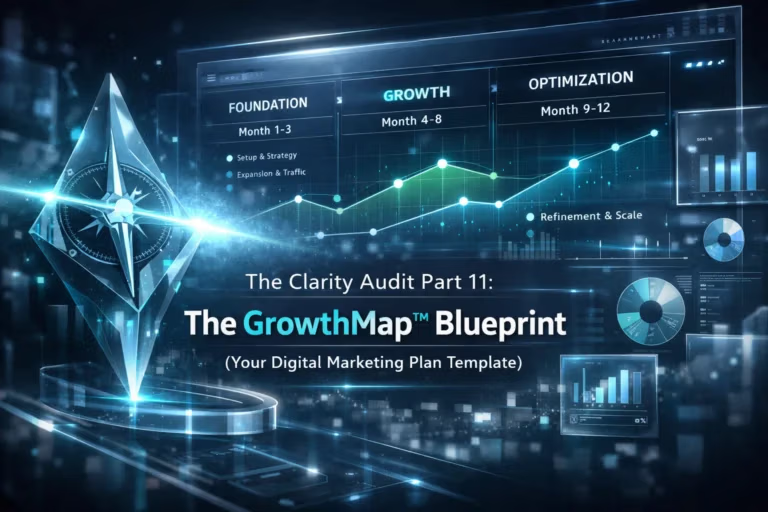
At Bearnedheart Web Services, we don’t just hand you a list of competitors and wish you luck. We help you translate competitive intelligence into a concrete GrowthMap™ that connects every piece of your digital strategy: from the gaps your competitors are leaving open to the exact messaging, website changes, and marketing tactics you need to capitalize on them.
If you’re ready to stop guessing and start strategically positioning your business for growth, book a 30-minute discovery call and let’s talk about what your competitors are missing: and how you’re going to fill that void.
Your rivals left the door open. Let’s walk right through it.