Are You Stuck on Page 2 of the Local Map Pack While Your Competitors Rake in Calls?
Working with local SEO for small business, you probably know the feeling. You Google your service in your city, and there they are: your competitors, sitting pretty in that coveted 3-pack at the top of the search results. Meanwhile, your business is buried somewhere on page 2, invisible to the exact customers you’re built to serve.
Here’s the truth: mastering local SEO for small business isn’t about gaming the system or stuffing keywords into every corner of your Google Business Profile. It’s about understanding what Google actually rewards in 2026: and it’s not what most “SEO gurus” are telling you.
This is your blueprint. The real one. No fluff, no outdated tactics, just the strategies that are working right now to dominate the local map pack.
The Myth You Need to Stop Believing Right Now
Let’s kill a sacred cow: geotagging your photos does absolutely nothing for your rankings.
You’ve heard it before: some agency tells you to manually add GPS coordinates to every image you upload to your Google Business Profile. They promise it’ll boost your local relevance. It won’t.
Why? Because Google strips EXIF data (including geotags) from uploaded images to protect user privacy. What Google does care about is user-generated content: photos uploaded by your actual customers, reviews with images, and the behavioral signals that come from real engagement.
“Google’s algorithm has evolved to prioritize authentic user signals over manipulated metadata. The businesses winning in local search are the ones generating genuine customer engagement, not those trying to hack the system with geotagged photos.” : Sterling Sky Inc., Local SEO Research 2026
Stop wasting time on tricks. Start building real authority.

The 2026 Edge: What Google Actually Ranks in the Map Pack
Here’s what separates the businesses dominating the local map pack from the ones stuck in obscurity:
Behavioral Signals Are King
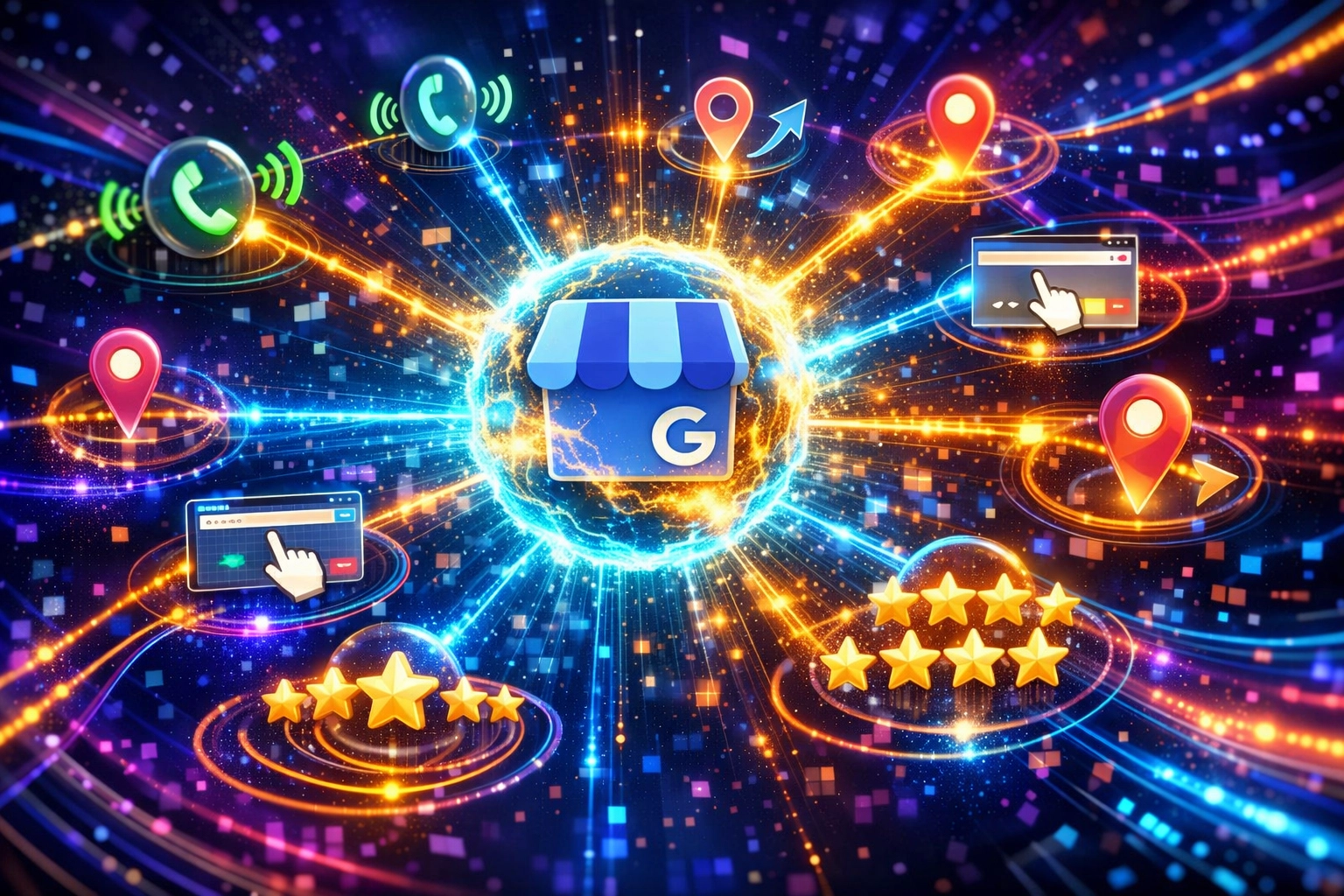
Google doesn’t just look at your profile: it watches how people interact with it. Every click matters:
- Clicks to call (high-intent signal)
- Driving directions requests (shows you’re visit-worthy)
- Website clicks (engagement depth)
- Dwell time on your profile (are people staying or bouncing?)
When your Google Business Profile generates these actions consistently, Google interprets it as a signal of relevance and quality. You move up.
Actionable Tip: Add a clear call-to-action in your GBP description. “Call us now for a free quote” or “Get directions to visit our showroom today” aren’t just marketing copy: they’re engagement triggers that feed Google’s algorithm.
The “Un-Optimization” Trend
This might sound counterintuitive, but the businesses winning in 2026 are the ones that don’t look over-optimized. Google has gotten smart enough to detect bot-like behavior: profiles that are stuffed with keywords, posted to every single day with robotic consistency, or littered with fake reviews.
The winning move? Make your profile look human.
- Post updates when you have something real to share, not just to “stay active”
- Respond to reviews authentically, not with templated responses
- Use natural language in your business description, not keyword soup
Google rewards businesses that feel genuine because those are the ones real customers trust.
The Data You Can’t Ignore: What Actually Moves the Needle for Local SEO for Small Business
Let’s look at the receipts. According to Whitespark’s 2026 Local Search Ranking Factors Study, here’s what’s proven to impact your position in the map pack:
- Google Business Profile completeness (primary category, accurate NAP, hours, attributes)
- Review signals (quantity, recency, sentiment, and response rate)
- On-page signals (localized content, schema markup, mobile optimization)
- Behavioral engagement (clicks, calls, direction requests)
- Citation consistency (your business information matching across the web)
Notice what’s missing? Gimmicks. Shortcuts. Black-hat tactics.
“Businesses that maintain citation consistency across directories and prioritize Google Business Profile accuracy see a 67% higher chance of ranking in the top 3 local pack results.” : BrightLocal, 2026 Consumer Behavior Report
The GBP Tethering Strategy
Here’s a pro move most businesses miss: tethering your Google Business Profile to your website and broader digital ecosystem.
Your GBP shouldn’t exist in a vacuum. Every post you publish, every service you add, every photo you upload should connect back to a corresponding page on your website. This creates a “trust web” that signals to Google: this business is legitimate, active, and authoritative.
If you haven’t audited your GBP for these connections, start here: The Clarity Audit Part 2: Is Your GBP Working or Just Existing?
Actionable Tip: For every service you list in your GBP, create a dedicated landing page on your website. Link to it in your GBP posts and description. This amplifies your topical authority and gives Google more signals to rank you higher.
The Visual AI Advantage: Why Your Images Matter More Than Ever
Google’s AI can now “read” images. Not just the alt text: it’s analyzing what’s actually in the photo. This means the images you upload to your GBP need to:
- Show your actual business (storefront, team, workspace)
- Depict your services in action (before/after shots, work in progress, happy customers)
- Be high-quality and recent (blurry photos from 2019 aren’t cutting it)
When Google’s Visual AI sees consistent, relevant imagery that matches your service categories and location, it reinforces your profile’s legitimacy.

The Map Pack Ranking Blueprint (Your 90-Day Action Plan)
Ready to actually do something with this information? Here’s your step-by-step roadmap to outrank your competition:
Month 1: Foundation & Optimization
- Audit your NAP (Name, Address, Phone) across every directory, citation, and platform
- Complete every field in your Google Business Profile (services, attributes, hours, service areas)
- Choose your primary category carefully: be as specific as possible (e.g., “Emergency Plumber” beats “Plumber”)
- Upload 10-15 high-quality photos of your business, team, and services
- Write a compelling business description that includes your focus keyword naturally and highlights your unique value
Month 2: Engagement & Authority Building
- Implement a review generation system: ask every satisfied customer to leave a Google review
- Respond to 100% of reviews (positive and negative) within 48 hours
- Post weekly GBP updates (special offers, blog posts, community involvement)
- Build 10-15 local citations in relevant directories (Yelp, industry-specific platforms, local chambers)
- Add LocalBusiness schema markup to your website
Month 3: Behavioral Signals & Refinement
- Track your GBP Insights data: measure clicks, calls, direction requests, and website visits
- A/B test your CTAs in your description and posts to increase engagement
- Create location-specific landing pages on your website and link to them from your GBP
- Encourage photos from customers (incentivize with a small discount or mention)
- Monitor your ranking position and adjust based on what’s working
Actionable Tip: Set a calendar reminder every Monday to check your GBP Insights. You’re looking for trends: what types of posts generate the most calls? What days see the highest engagement? Double down on what works.
Why Local SEO for Small Business Outpaces Traditional SEO
Here’s the part most businesses don’t realize: local SEO for small business is faster and easier than competing in traditional organic search.
Why? Because only businesses with a verified Google Business Profile can compete in the map pack. That immediately cuts your competition down to a fraction of what you’d face trying to rank a blog post or service page organically.
Plus, the customers searching for “plumber near me” or “lawyer in [city]” are high-intent, ready-to-buy leads. They’re not browsing: they’re looking to hire today.
According to BrightLocal’s 2026 Consumer Survey, 87% of consumers use Google to evaluate local businesses, and 76% of people who search for something nearby visit a business within 24 hours.
You’re not just optimizing for visibility. You’re optimizing for revenue.
The Heartbeat: Consistency Over Time
The businesses that win the long game in local SEO aren’t the ones that launch aggressive campaigns for three months and then ghost their profiles. They’re the ones that maintain a consistent heartbeat: regular posts, steady review flow, ongoing engagement.
Think of your Google Business Profile like a living organism. It needs feeding, nurturing, and attention. Set up systems that keep it healthy without consuming your entire day:
- Automate review requests with a simple follow-up email or SMS after service completion
- Batch-create GBP posts once a month and schedule them
- Train your team to respond to reviews and questions promptly
- Audit quarterly: check for broken links, outdated hours, and new opportunities
This isn’t a sprint. It’s a sustainable strategy that compounds over time.
Your Next Move: Stop Guessing at local SEO for small business and Start Ranking
You’ve got the blueprint. You understand the myths, the real ranking factors, and the step-by-step plan to dominate your local market.
Now it’s time to execute.
If you’re ready to stop spinning your wheels and start getting real results from your digital presence, let’s talk. At Bearnedheart Web Services, we specialize in helping small businesses like yours build clarity-driven strategies that generate leads, not just traffic.
Book a discovery call at https://calendly.com/bearnheartbiz/free-discovery-call or call us directly at (712) 798-9080. Someone well-informed will walk you through exactly what your business needs to break through the noise and start showing up where your customers are searching.