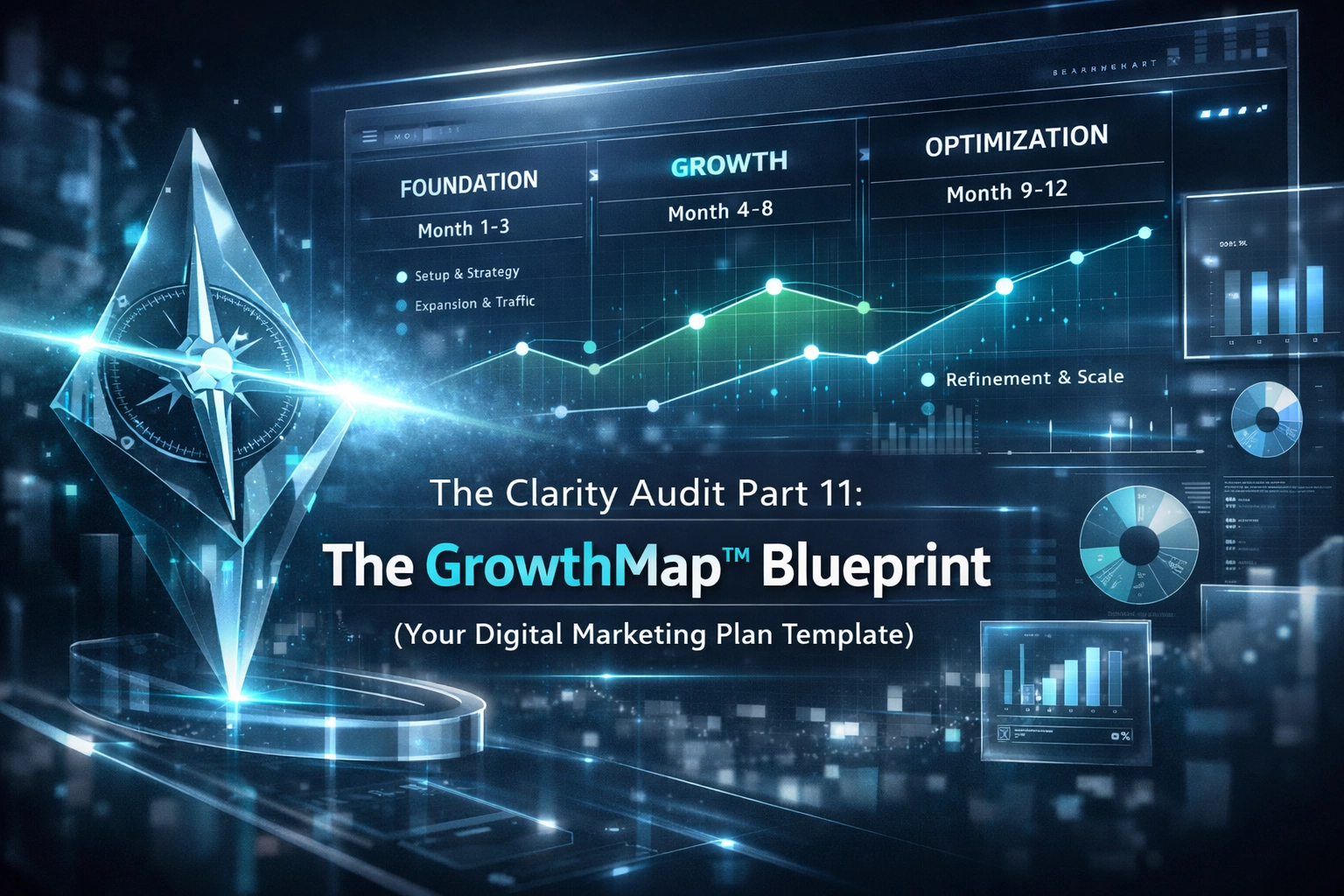
Ever finish an audit and think, “Cool… now what?” That’s where a lot of small businesses get stuck. After 10 parts of this series, you’ve collected a ton of info—from website clarity notes to competitor screenshots—but without a clear digital marketing plan template to bring it all together, that data just turns into noise. You end up reacting, tweaking random things, and still wondering why the leads aren’t steady. Today, we’re crossing the finish line of the Clarity Audit by turning all that raw information into your GrowthMap™, the final, phased roadmap for your business growth.
If you want to revisit the “inputs” that feed this plan, here are the big ones:
- Part 1 (Website Clarity): https://bearnedheart.com/the-15-minute-website-clarity-audit-why-visitors-arent-turning-into-leads/
- Part 2 (Google Business Profile): https://bearnedheart.com/gbp-clarity-audit-is-your-profile-working-or-just-existing/
- Part 10 (Competitor Analysis): https://bearnedheart.com/the-clarity-audit-part-10-competitor-analysis-ethical-ways-to-learn-from-your-rivals/

What the GrowthMap™ Is (And Why It Feels Like Relief)
The GrowthMap™ is our strategy-first blueprint for turning scattered digital efforts into a cohesive, lead-generating machine.
It’s not a giant task list. It’s not a generic “digital marketing plan template” you download and try to force onto your business.
Instead, it’s a custom roadmap built from what your audits revealed. It tells you what matters first, what can wait, and what “winning” looks like over the next 12 months.
Here is the catch: most businesses don’t fail because they’re lazy. They fail because they’re doing ten things halfway, in the wrong order. The GrowthMap™ fixes the order.
Strategy-First: Why We Look at 8 Competitors
A lot of marketing plans start with tactics. More posts. Better ads. New website. New logo. New something.
We don’t start there.
We start by figuring out what’s actually going to move the needle for your business. That means we look at your offers, your customers, your sales process, and your local market.
On top of that, we analyze 8 competitors specifically.
Why eight? Because it’s enough to spot patterns without cherry-picking one “unicorn” competitor and assuming their results will magically copy over to you. With eight, you can see what messages keep repeating, what offers people push, how they position themselves, and where the gaps are.
And once you see those gaps, you can skip months of guesswork.
Actionable Tip: Pull up 8 competitors and answer three questions: What do they promise? What do they want you to do next? What proof do they show (reviews, case studies, photos)? That’s your baseline.
The 3-Phase Roadmap: A Digital Marketing Plan Template You’ll Actually Use
This is the core of the GrowthMap™. It’s a 3-phase plan, because doing everything at once is the fastest way to burn out and still not get results.
Phase 1 (Months 1–3): Foundation
Foundation is where you fix the stuff that quietly kills performance.
If your messaging is fuzzy, you can’t convert. If your tracking is wrong, you can’t improve. If your Google Business Profile is half-done, you lose local leads to someone who simply looks more legit.
So this phase tightens the basics. It gets your website clarity and conversion path cleaned up, your local visibility (especially GBP) in a good spot, and your analytics telling the truth. When the foundation is solid, every future effort works harder.
Phase 2 (Months 4–8): Growth
Growth is where you stop relying on “hope marketing.”
This is the phase where we build momentum with the things that compound: content that answers real buyer questions, pages that rank for the searches you actually care about, and lead capture that turns visitors into contacts you can follow up with.
It’s also where you start seeing consistency. Not just a random good week. You start seeing a pattern: traffic comes in, the right people take action, and your pipeline doesn’t feel so fragile.
Phase 3 (Months 9–12): Optimization
Optimization is where you scale without getting sloppy.
By this point, you’ve got enough data to know what’s working. So instead of adding ten new channels, you tighten what you already built. You improve conversion rates, refine offers, and double down on the pages and messages that produce real leads.
This phase is what turns “we’re trying things” into “we know what works.”

SMART Goals: Because “More Marketing” Isn’t a Goal
The GrowthMap™ isn’t just “do these tasks.”
It includes SMART goals, which is a fancy way of saying: we pick targets you can measure and deadlines you can stick to.
Examples look like this:
- Increase organic traffic by 30% in 6 months
- Improve conversion rate from 1% to 2% by Month 4
- Increase GBP calls/directions requests by 20% by Month 3
When your goals are clear, your plan stays focused. You can tell what to keep, what to fix, and what to cut.
Implementation: Genesis vs Momentum/Elite (DIY vs Fractional Support)
Once the roadmap is built, you’ve got two good options.
Genesis is the DIY version. You get the plan, you get the priorities, and you (or your team) implement it at your pace. This is perfect if you’re hands-on and just need clarity and direction.
Momentum/Elite is where you bring in a fractional team to help drive it. Same roadmap. More execution support. More momentum. This is usually the move when you want to scale 2–5x and you don’t want marketing to become your second full-time job.
Either way, you’re not guessing anymore. You’re following a plan built from your real audit data.
What to Do Next
If you want the deeper breakdown on the full 12-month approach, start here:
https://bearnedheart.com/what-is-a-12-month-digital-growth-plan-and-why-your-business-needs-one/
If you want to talk it through and see what your GrowthMap™ would look like, book a call:
👉 https://calendly.com/bearnheartbiz/consulting
Or call (712) 219-4016 if you’d rather do it the old-school way.
You did the audits. Now let’s turn them into a map.